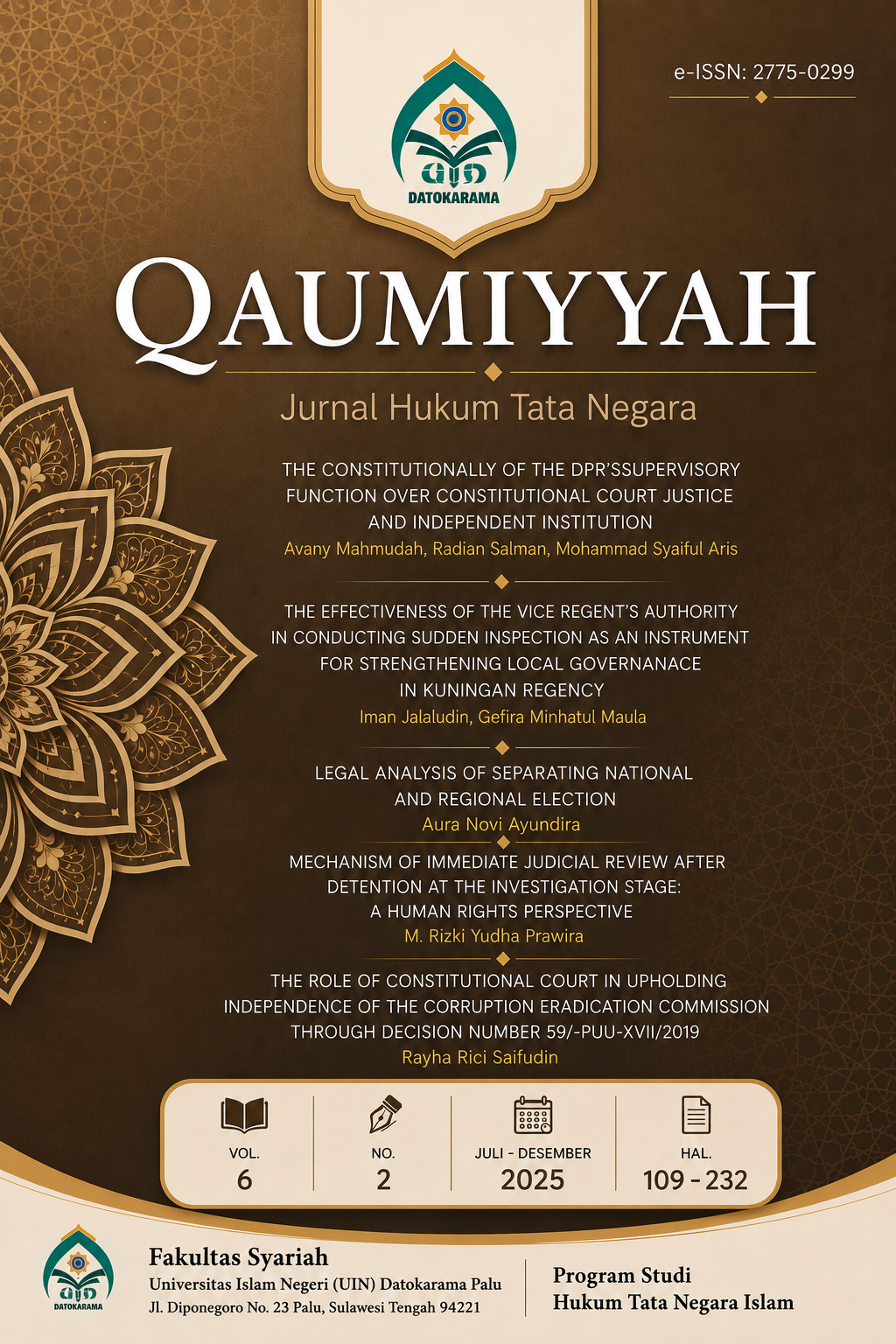
LEGAL ANALYSIS OF SEPARATING NATIONAL AND REGIONAL ELECTION
DOI:
https://doi.org/10.24239/qaumiyyah.v6i2.283Keywords:
Constitutional Court, Democracy, Election Separation, Principles of Good Governance, Voter ParticipationAbstract
This study examined the legal aspects related to the separation of the organization of National and Regional Elections based on the general principles of good governance. Constitutional Court Decision Number 135/PUU-XXII/2024 mandates this separation to alleviate the burden on election organizers and improve the quality of election implementation. However, this separation inevitably raises administrative and juridical challenges, such as regulatory inconsistencies and the potential extension of regional officials' terms, requiring regulatory revisions and more effective coordination among organizing institutions. The research method employed is a normative approach with analysis of legislation and a conceptual framework. The findings emphasize the importance of maintaining the application of the principles of direct, general, free, secret, honest, and fair elections to ensure the credibility of democracy and sustainable governance. Mitigation efforts against the decline in voter participation and the complexity of coordination between central and regional governments are crucial in preserving political stability and the effectiveness of government rsityadministration.
Abstrak
Penelitian ini mengkaji aspek hukum yang berkaitan dengan pemisahan penyelenggaraan Pemilu Nasional dan Daerah yang berdasarkan pada prinsip-prinsip umum pemerintahan yang baik. Putusan Mahkamah Konstitusi Nomor 135/PUU-XXII/2024 mewajibkan pemisahan tersebut untuk meringankan beban penyelenggara serta meningkatkan mutu pelaksanaan pemilu. Namun, pemisahan ini juga pastinya akan menimbulkan tantangan dalam hal administratif dan yuridis, seperti ketidaksinkronan regulasi serta kemungkinan perpanjangan masa jabatan pejabat daerah, sehingga memerlukan revisi aturan dan koordinasi yang lebih efektif antar lembaga penyelenggara. Metode penelitian yang digunakan adalah pendekatan normatif dengan analisis peraturan perundang-undangan dan kerangka konseptual. Hasil penelitian menegaskan pentingnya menjaga penerapan asas pemilihan umum yang langsung, umum, bebas, rahasia, jujur, dan adil guna memastikan kredibilitas demokrasi serta tata kelola pemerintahan yang berkelanjutan. Upaya mitigasi terhadap penurunan partisipasi pemilih dan kompleksitas koordinasi antara pusat dan daerah menjadi hal krusial dalam mempertahankan stabilitas politik dan efektivitas penyelenggaraan pemerintahan.
Downloads
Published
Issue
Section
License
Authors retain copyright in their work and grant Qaumiyyah: Jurnal Hukum Tata Negara the right of first publication. Articles published under these terms are licensed under the Creative Commons Attribution-NonCommercial 4.0 International License (CC BY-NC 4.0): https://creativecommons.org/licenses/by-nc/4.0/. Users may share and adapt licensed material for non-commercial purposes with appropriate attribution, a link to the licence, and an indication of changes. Third-party material excluded from the licence requires separate permission where applicable. Earlier articles retain any different terms expressly stated in their publication.